
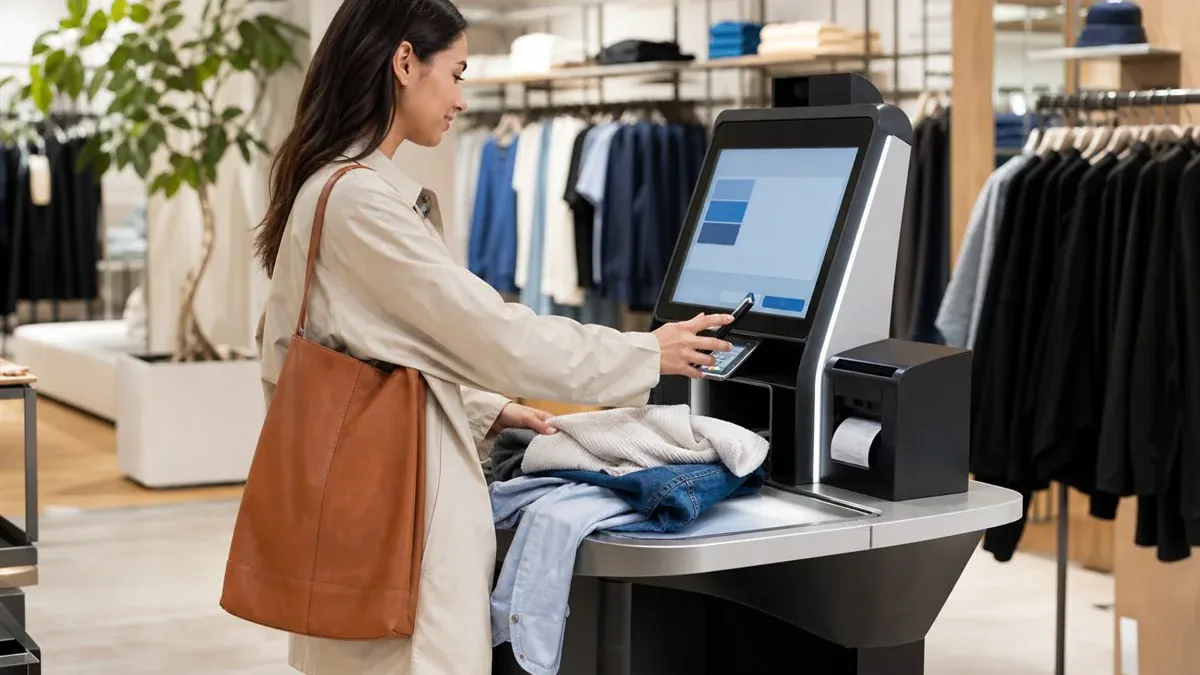
What difference does RFID make between self-service and swipe-coded cash?
Scanning is usually based on a camera or scanner to read visible 1-D, 2-D code, and is done with a single-format view. The RFID self-service self-checkout is read by the RFID RF-label-screen response, which allows multiple product tags to be collected when the area is properly designed.
The two approaches are border-specific. The scrutinizing equipment is mature, the commodity code system is common and suitable for single-spore confirmation; RFID is suitable for retail scenarios where individual labels have been bound and require bulk identification, but additional electronic tags, radio-frequency area controls and system interfaces are needed.
What Equipment Is Required for RFID Self-Checkout?
| Composition | Main roles |
|---|---|
| RFID Commodity Tag | Maintenance of readable commodity operational identification and binding of SKU and single product files |
| RFID Identification Area | Limits the goods the customer is paying for in this transaction; counter-top and cabinet units provide different read spaces |
| Self-service self-checkout terminal | Show list of goods, prices, quantities and operational status |
| Paying equipment | Complete payment and return the definite result of the transaction |
| Barcode scanning and printing (optional) | Scans barcodes on untagged items or prints receipts and operation records; configured per project |
| Retail management system | Data on commodities, prices, inventories, membership and sales status provided |
The system also verifies whether the goods are sold, price valid, payment successful and, in exceptional cases, allows review by the customer or staff.
The terminal format directly affects usable item count and customer flow. Counter-top units usually sit beside the till, where customers place goods on the surface read zone, which suits opening an extra self-service lane at peak times. Cabinet units enclose the read space inside the body, keeping stray reads more controllable, and suit unattended areas or sites where the read range must be limited. For both formats, the number of items read in a batch, processing time and shielding range must be confirmed with real goods rather than planned from rated values.
What Is the Complete RFID Self-Checkout Workflow?
- Customers put the goods they're about to buy in the designated area.
- Batch reading of RFID Tag and completion of weighting
- Retail systems match commodity, price and promotion rules with label codes
- Terminal display list of goods, confirmed by the customer, quantity and amount
- Paying for equipment to complete the transaction and return to a successful or failed state
- Updates of the sale or permitted movement of goods after successful payment
- Synchronize sales results to inventory, order and membership systems
Read, pay and update the inventory. When the network is interrupted, the payment time is out or the inventory interface fails, the transaction status should be preserved and the path for compensation or manual processing should be provided, and the inventory should not be deducted by the label alone.
Why would RFID identify multiple goods at once?
The common UHF RFID system can detect multiple passive labels in the RFID Reader area and receive responses to each label in accordance with the rules of communication.
RFID Tag and RFID Reader are available.What's the RFID? How does it work, how it works and how it works?。
Which stores should adopt self-checkout first?
Self-checkout earns its place by reading several items at once, so it suits stores where customers buy multiple items and unit-level tagging is already in place. Where baskets are small, order values are high and customers need more advice, staffed checkout is usually the better fit.
- Apparel and sports goods stores where customers buy several items and size and colour combinations are many
- Stores or temporary shops with concentrated peaks where staffed tills queue up
- Item-level tagging and inventory accounting are already in place, so goods and labels match one to one
- Small items such as jewellery and cosmetics need smaller labels and a smaller read zone, and mixed loads must be tested group by group
In recent store projects, self-checkout is rarely rolled out on its own. The usual order is to finish item tagging and counting checks, connect checkout to the same item status, and finally attach the gate's verification rules to the same sales records. Staffed checkout normally stays in place alongside self-service for customers who are not comfortable using it.
What does RFID need to look at?
- The label should be properly bound to the specific commodity and verify the location of the installation and the material of the commodity
- Identification areas need to cover targeted commodities while reducing access to nearby shelves or other customer commodities
- Re-slotting, rereading or manual checking should be permitted in the event of a missing settlement list
- Payments, inventories and member interfaces should distinguish between success, failure, time overrun and duplicate submission
- Remittances, exchange of goods, cancellation of payments need to be accompanied by a return to the correct state of stock
If the goods are not included in the list, theWhy is the RFID missing? The common reason and the way it was checked.Check labels, energy and return links; if you read outside the identified area, pressWhy does the RFID read? How do we control the reading area?Check power, antennas, shielding and operational filtering.
The overall relationship between door-to-door count, settlement and protection is accessibleRFID Retail Management SolutionsKeep understanding.
FAQs
Does RFID need a scrutinizing code?
When labelling and identifying areas are appropriate, no one-by-one sweep is required and equipment is available for bulk reading of the regional commodity labels; manual review should continue to be supported for abnormal commodities.
Can RFID identify multiple items at a time?
It is possible, but the amount that can be identified is determined by labels, material, placement, equipment and area identification design, and cannot be set off from the commitment of fixed quantities under field conditions.
Can RFID self-checkout connect to the membership system?
Yes. The self-service self-checkout system can call on membership, preferences and points rules through interfaces, but needs to be clear about how the interface fails, preferential conflicts and payment cancellations are handled.
Will the inventory be automatically updated after the commodity payment?
The system should be based on a clear payment success and business recognition status and address failure retry and reconciliation.